
The Portfolio view is your single source of truth for nature data across every site you manage. It bridges the gap between landscape scale oversight and ground truth precision, allowing you to move effortlessly from a global view to specific operational details within one unified platform.
By aggregating data from multiple sources, it acts as a centralized dashboard that unifies data from thousands of locations into one powerful view. This high level oversight is powered by merging landscape scale Habitat Insights with the ground truth precision of Species Insights. By layering geospatial trends like habitat connectivity and vegetation health with biological reality from eDNA and bioacoustics, Portfolio allows you to spot outliers and performance gaps across different business units or countries instantly.
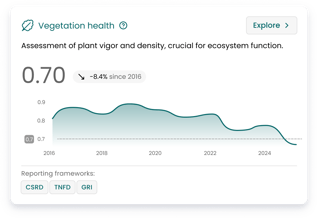
The platform provides several integrated tools designed to help you organize this information into a clear and manageable strategy.
Key Features
-
Aggregated Nature Metrics: Unify nature data from multiple sources, including eDNA, bioacoustics, and geospatial data for thousands of sites globally to establish portfolio-level baselines.
-
Risk Heat Maps: Instantly identify which specific sites are at high risk for invasive species, habitat loss, or water stress to spot outliers across your organization..
-
Predictive Analytics: Leverage AI and geospatial data to model potential risks and predict species distribution where sampling has not occurred yet.
-
Automated Reporting: Access standardized metrics and built in explainers that guide you toward reporting for frameworks like TNFD, CSRD and GRI.
- Site Grouping and Benchmarking: Customise your view by grouping assets by region, business unit, or operational phase to align nature data directly with your internal business structures.
- Mitigation Hierarchy Visualisation: Group your assets by your conservation actions. Avoidance, Minimization, or Restoration. This creates a defensible audit trail using standardized habitat metrics to prove your impact.
-
Performance Benchmarking: Compare the performance of different asset classes or regions to understand which areas are underperforming.
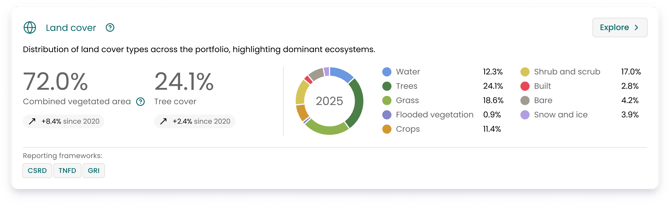
These capabilities provide the intelligence needed to tackle real world business challenges. By applying these tools, you can move from general oversight to targeted action in the following ways.
-
Prioritizing Interventions: Focus your limited budget and efforts on the small percentage of sites that represent the majority of your environmental risk.
-
Due Diligence and Site Selection: Screen potential project locations early to steer clear of ecological no go zones like critical habitats for endangered species.
-
Tracking Nature Positive Progress: Monitor restoration efforts over time across multiple sites to provide audit ready proof of recovery for investors.
-
Supply Chain Visibility: Track the nature impact of your suppliers rather than just your direct operations to identify hidden financial threats.
-
Regulatory Compliance: Generate the specific biodiversity metrics demanded by regulators to satisfy the most demanding stakeholders.
Portfolio moves your nature strategy from a reactive compliance task to a proactive management tool. It simplifies the full complexity of nature on the ground into the simple insights humanity needs to protect what matters, while simplifying the complexity of reporting against frameworks like TNFD and CSRD, providing the auditable evidence needed to satisfy investors and regulators alike.